
Planet Catalogue System
Team: Junhan Chen, Shengda Gao, Yiwen Wang, Yang Tian, Siyuan Lin
Course: CPT109 C Programming and Software Engineering 1
Institution: Xi’an Jiaotong-Liverpool University
Date: Nov 2024 – Dec 2024
Language: C (C90)
Project Overview
This project involves the development of a Planet Catalogue System, a C-based software application designed to manage, search, and analyse planetary data for research purposes.
The system was implemented as a modular program, supporting multiple user roles (Admin and Researcher) and providing functionalities such as planet data management, account handling, search and retrieval, and statistical reporting.
Problem Specification
Overall Requirement
The system was developed as a C-based software application for managing and analysing planetary data.
It provides a structured environment for storing, retrieving, and processing information related to planets and user activities.
The main functionalities of the system include:
- Planet Management: storing and maintaining attributes such as name, type, size, and distance from the star
- User Accounts: managing researcher accounts with unique identifiers
- Search and Retrieval: querying planets based on different attributes
- Statistical Reporting: generating statistics on catalogued, discovered, and observed planets
The system supports two user roles:
- Admin
- Researcher
Each role is associated with different functionalities and access permissions.
Admin Functional Requirements
The admin user is responsible for managing both planetary data and system users.
Planet Data Management
- Add new planet records
- Modify existing planet attributes
- Delete planet records
Statistics Access
- View total number of catalogued planets
- View number of discovered planets
- View number of observed planets
Researcher Account Management
- Create researcher accounts
- Modify account information
- Delete researcher accounts
- Monitor researcher activity
Researcher Functional Requirements
The researcher user focuses on interacting with planetary data.
Planet Search and Retrieval
- Search planets by name, type, or other attributes
- View detailed information of selected planets
Account Management
- Register a new account
- Modify personal account information
- View previous activity records
Analysis
Data Structure Design
The system is designed based on structured data representations for both planetary data and user accounts.
Two main data types are defined:
- Planet structure
- User (Researcher/Admin) structure
The planet structure stores key attributes such as:
- name
- type
- size
- distance from the star
The user structure stores:
- account ID
- username
- role (Admin or Researcher)
- activity-related information
To manage multiple records efficiently, the system uses linked data structures, allowing dynamic insertion and deletion of data without fixed size limitations.
System Architecture
The system follows a modular design, where different functionalities are organised into independent modules.
The overall workflow of the system can be summarised as:
- User login or registration
- Role identification (Admin or Researcher)
- Access to role-specific menu
- Execution of selected functions
- Return to menu or exit
This structure ensures that the program remains organised and scalable, with clear separation between different functionalities.
Functional Modules
The system is divided into several functional modules:
Authentication Module
- User login
- User registration
- Role verification
Planet Management Module (Admin)
- Add planet
- Modify planet
- Delete planet
Search Module
- Search by name
- Search by type
- Display detailed planet information
Statistics Module
- Count catalogued planets
- Count discovered planets
- Count observed planets
Account Management Module
- Create accounts
- Modify account information
- Delete accounts
- Track user activity
Each module is designed to operate independently while interacting with shared data structures.
Program Flow
The program is implemented as a menu-driven system.
After login, users are directed to different menus based on their roles:
- Admin Menu
- Researcher Menu
Each menu provides access to relevant functionalities, and users can repeatedly perform operations until they choose to exit the system.
This approach ensures usability and allows clear interaction between the user and the system.
System Architecture
The system follows a modular design, where different functionalities are organised into independent modules.
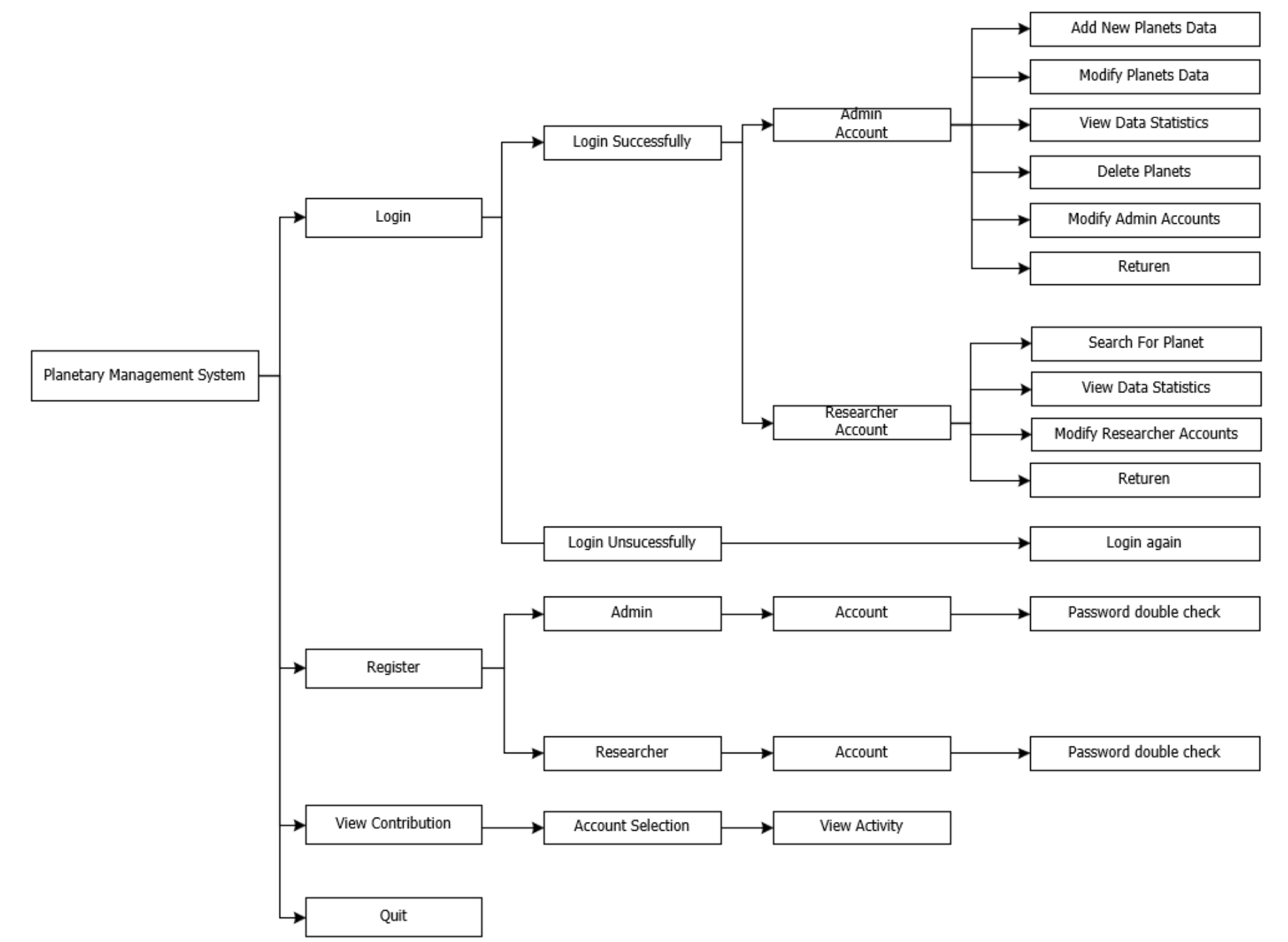
The overall workflow of the system can be summarised as:
- User login or registration
- Role identification (Admin or Researcher)
- Access to role-specific menu
- Execution of selected functions
- Return to menu or exit
Implementation
Overview
The system was implemented in C using a modular structure.
Each functionality was encapsulated into separate functions, allowing clear organisation of the program and easier maintenance.
The implementation integrates:
- structured data types
- linked data structures
- file-based storage
- menu-driven interaction
Data Storage and File Handling
Planet data and user account information are stored using external files.
- Planet data is stored in a file (e.g.
planetcat.txt) - User account data is stored separately
File operations are implemented using standard C functions:
fopen()for opening filesfprintf()for writing datafread()/fgets()for reading datafclose()for closing files
This approach allows persistent storage of data across program executions.
Dynamic Data Management
The system uses dynamic memory allocation and linked lists to manage data.
malloc()is used to allocate memory for new records- Linked lists are used to store and traverse planet and user data
This design enables:
- flexible insertion and deletion of records
- efficient traversal for search operations
- avoidance of fixed-size data limitations
Core Functional Implementation
Planet Data Management (Admin)
increasep1()is used to add new planet datamodifyPlanet()updates existing recordsdeletePlanet()removes planet entries
These functions operate by:
- locating the target record in the linked list
- modifying or deleting the data
- updating the file to reflect the changes
Search Functionality (Researcher)
searchPlanet()allows users to search for planets based on different attributes
The implementation:
- takes user input
- traverses the linked list
- compares values using
strcmp()or numerical checks - returns matching planet data
Account Management
creatacc()is used to create new accountsmodifyAccount()updates user credentials
The system ensures:
- unique account identification
- validation of user input
- persistent storage in file
Statistics Function
viewStatistics()calculates and displays system statistics
This includes:
- number of catalogued planets
- number of discovered planets
- number of observed planets
- number of registered users
Program Interaction
The system is implemented as a menu-driven interface.
mainmenu()displays the main system menu- Different menus are presented based on user role
User interaction is handled using:
printf()for displaying optionsscanf()/fgets()for input
This structure enables continuous operation until the user chooses to exit the program.